A symptom offers information that feels immediate, while a desired outcome may belong to a later time. That contrast makes a proposed shortcut easy to understand: could what someone notices now reveal whether a treatment will succeed? The scientific task is to specify what the shortcut would predict, when it would be used, and how accurately it would need to work.
Reading evidence for that purpose requires several separate judgments. A description organizes observations. A forecast makes a claim about an outcome not yet known. A causal explanation asks what would change under a different intervention. This article examines how to keep those judgments separate when considering tirzepatide, so that a useful research result does not acquire a stronger personal meaning merely through its wording.
Define a symptom group
These post-hoc analyses examined SURMOUNT trials separately. One reported nausea, vomiting or diarrhea event defined the symptom group; symptoms were not randomized.[1]
A yes-or-no classification compresses a history into a label. Once that compression occurs, the label alone cannot recover when an experience began, whether it recurred, or how much it mattered to the person. Those are separate dimensions of measurement. A reader should therefore distinguish a convenient way to organize records from a complete account of the experience being classified.
The definition also determines what a comparison can discriminate. Suppose a proposed label places markedly different histories in the same category. An average for that category cannot reveal whether those histories carry the same information about a later outcome. To investigate that question, the underlying histories would need to remain available, and the proposed distinctions would need to be specified before interpreting their apparent usefulness.
Recording an event and deciding what it means are different operations. A label can be reproducible because readers apply its definition consistently, yet still have little value for a particular decision. Conversely, a richer description is not automatically a better forecast: additional detail must earn its place by improving the intended inference. The important question is what information the classification preserves for the task at hand.
Terminology deserves the same discipline. The guide to product names and scope provides background for identifying what a claim refers to; the precision of a name cannot substitute for evidence supporting the claim.
Follow the observed data
Weight observations after treatment discontinuation were excluded, as were observations after diabetes rescue in SURMOUNT-2. Both symptom groups lost weight.[1]
Every analysis needs a rule connecting a person, a measurement and a time. Without that rule, an apparent change in an average could reflect a change in who contributes to it. The denominator is therefore part of the scientific question. It tells the reader which observations are being summarized, rather than simply providing a number to place beneath the numerator.
Two distinct problems can arise when records are unavailable. A measurement may belong to the intended question but be absent, or it may fall outside the question as defined. Reconstructing a missing value addresses the first problem only under stated assumptions. Expanding the question to include additional experiences addresses the second. More elaborate calculation cannot make these choices interchangeable.
If the availability of an outcome depends on circumstances related to that outcome, the available records may tell a different story from all intended records. That possibility does not establish the direction or size of an error. A defensible explanation would identify the circumstances being considered, describe how they could affect inclusion, and show whether reasonable alternatives would materially change the interpretation.
Consistency across groups matters as well. Applying the same observation rule makes the comparison easier to describe, but it does not prove that every group loses equivalent information under that rule. The reader needs to understand the connection between observation and the intended population before treating an apparently clean comparison as a complete account of what happens after a decision.
Read the outcome distribution
SURMOUNT-1 randomized adults without diabetes. Treatment-regimen analysis included outcomes regardless of discontinuation; efficacy analysis assumed intended treatment.[2]
A threshold converts a continuous outcome into an answer to a particular question: did the outcome reach this level? Changing the threshold changes the question. When targets are ordered along the same outcome scale and refer to the same people and time, attaining a more demanding target necessarily includes attaining the less demanding one. The resulting categories overlap by construction.
This creates a useful distinction between a cumulative description and a partition. A partition assigns each person to one separate category; a cumulative description allows a person to qualify at several levels. Adding cumulative percentages would count some people repeatedly. Subtracting them has a different meaning: under a common definition and population, it describes the interval between the targets rather than a new treatment effect.
Uncertainty around an estimated percentage also differs from variation among individuals. The first concerns how precisely a population quantity has been estimated. The second concerns how differently people may fare. Even perfect knowledge of a population percentage would leave unresolved which particular person will attain the target. A narrow interval can improve confidence in a group estimate without becoming a narrow personal forecast.
If percentages are estimated using assumptions about unavailable outcomes, multiplying by the number enrolled does not recover a documented roster of responders. It produces a calculation based on the estimate. Calling that result an observed headcount would erase the distinction between a model and a record.
Finally, a distribution describes outcomes under its stated conditions. To attribute those outcomes to an intervention, a comparison must address what would have happened under the relevant alternative. To use the distribution for prediction, information must connect an individual to their possible outcome. These are additional inferential tasks, not properties supplied merely by a more detailed graph.
Read thresholds
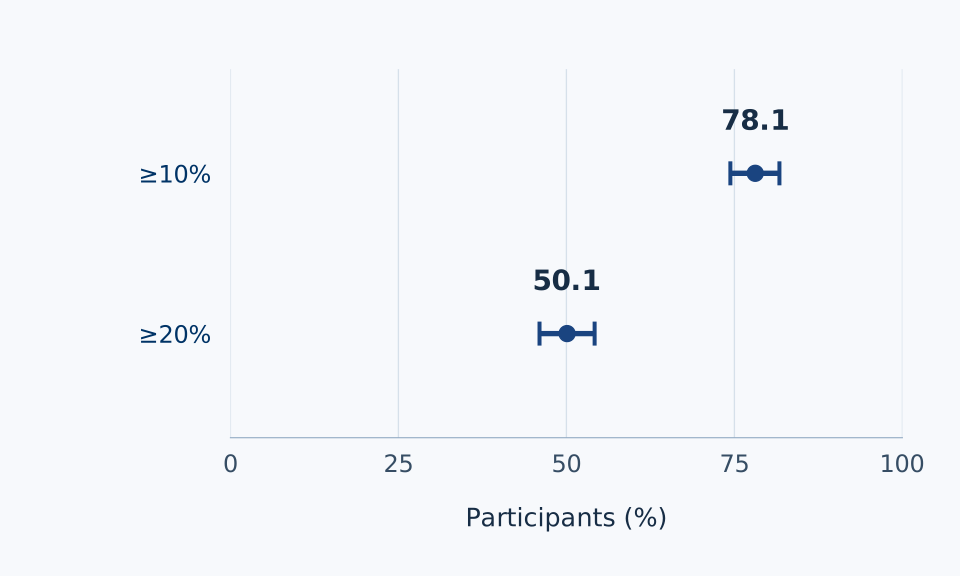
Read the chart as a table
| Threshold | Estimate (%) | Lower (%) | Upper (%) |
|---|---|---|---|
| ≥10% | 78.1 | 74.4 | 81.7 |
| ≥20% | 50.1 | 46.0 | 54.2 |
Ask what would count as prediction
ICH warns that comparing subsets defined by events after treatment can mix treatment effects with differences between the people in those subsets.[4]
A prospective rule needs a clear moment of use. Information available after the outcome cannot fairly support a forecast made before it. Even information collected earlier may be unsuitable if the intended user would not yet have had access to it. Specifying that moment prevents hindsight from entering the rule disguised as predictive insight.
The outcome must be equally precise. Predicting a later measurement, reaching a chosen target and making a worthwhile treatment decision are different tasks. A rule could perform well for one while being unhelpful for another. Its evaluation should therefore retain the outcome definition that motivated its use, rather than selecting whichever endpoint makes the rule appear most persuasive.
Performance also needs examination beyond the observations used to construct the rule. Otherwise, a pattern tailored to the original records may be mistaken for a dependable relationship. The relevant comparison is whether the rule adds useful information beyond what would already be known at the decision point. Merely producing different predicted values is insufficient if those values do not improve the intended judgment.
Errors require attention in both directions. A favorable forecast could be wrong, and an unfavorable forecast could discourage an otherwise reasonable choice. Their importance depends on what action the forecast would change. This makes prediction an evaluation of consequences as well as accuracy. The peptide library can help organize background reading, while the proposed rule still needs evidence specific to its timing, outcome and use.
Test a causal explanation
Mediation in SURMOUNT-1–3 attributed up to 3.1% of the estimated treatment effect to symptoms including dyspepsia, not 3.1 body-weight percentage points.[1]
Association asks whether observations vary together. Prediction asks whether information helps anticipate an outcome. Causal analysis asks what would happen if something were changed. These questions can share measurements while requiring different arguments. A useful signal need not be a cause, and a plausible cause need not make a sufficiently accurate signal for a particular person's decision.
To interpret a proposed pathway, specify the alternative being imagined. Is the question about changing the treatment, changing an intermediate experience while holding other circumstances fixed, or changing an entire course of care? Those alternatives are not equivalent. An observed relationship cannot by itself determine which intervention would reproduce it, because the act of changing something may also change its surrounding conditions.
A share of an estimated effect is a ratio between quantities defined by an analysis. A change in body weight is a quantity on an outcome scale. Keeping the denominator visible prevents the ratio from being read as an amount an individual should expect. It also prevents a proposed explanation of an average contrast from becoming a claim about every person's pathway.
Causal interpretation would need an argument about competing explanations, measurement and the ordering of events. If an unmeasured circumstance influences both an intermediate experience and an outcome, simply relating the two does not isolate the effect of the intermediate experience. A sensitivity analysis can examine specified alternatives, but its conclusion remains tied to the alternatives actually considered. Scientific confidence comes from making that dependence visible rather than treating a model's output as a direct observation of causation.
Keep the starting point visible
SURMOUNT-4 used a 36-week open-label lead-in followed by 52 randomized weeks: 88 total. Randomization required attaining a tolerated target dose. Investigator-directed symptom support was available.[3]
A decision made after an initial period has a different information set from a decision made before it. By the later point, the person may have a history relevant to the choice. An evaluation that begins there should be interpreted as answering a question from that starting position. Rewinding its conclusion to an earlier decision would discard the conditions that made the later question meaningful.
Selection and random assignment address different problems. Random assignment can support a comparison among people eligible at that point. It does not erase the process determining who became eligible. To consider a broader population, one would need to examine whether the features governing entry could also change the result relevant to that population. That is a transportability question, requiring an explicit connection between settings.
The presence of assistance within a program poses another attribution problem. Observing outcomes where assistance is available does not isolate what the assistance contributes. Estimating that contribution would require a comparison capable of separating it from the other conditions of care. Without such a comparison, assigning credit to one component would turn a description of the program into an untested causal explanation.
For a reader, the practical distinction is between asking what choice is supported now and asking what the whole sequence of choices achieves. An answer about one stage can inform the first question without resolving the second. Keeping the starting point explicit preserves the value of the narrower answer while making the remaining question visible.
Weigh the evidence
Lilly funded the analysis; six authors were employees and shareholders.[1]
A disclosure supplies information about the circumstances of research. It does not tell the reader which numerical conclusion would change under a different arrangement. Treating a financial relationship as proof of an incorrect result skips the analysis; treating disclosure as proof that every concern has disappeared skips it as well. The appropriate next step is to examine how the reasoning could be checked.
That examination should connect the stated question to the measurements, the analysis and the conclusion. A reader should be able to identify where an interpretation depends on a choice rather than a directly recorded observation. Clear reporting makes those choices available for scrutiny. It does not require agreement with every choice, and it should allow disagreement to be attached to a specific consequence.
Consider also whether an appealing explanation has been granted more authority than its test supports. A coherent account can organize evidence and suggest a useful next investigation. To support an individual rule, however, the account would need to survive evaluation for that particular purpose. Plausibility is a reason to formulate a test, not a reason to dispense with one.
Confidence should track the narrowest conclusion that survives those checks. If alternative explanations remain compatible with the evidence, the interpretation should leave room for them. That restraint need not make the evidence useless. It identifies which part of the reasoning is secure enough to use and which part would change if additional information became available.
Keep safety separate
Zepbound delays gastric emptying and is not recommended with severe gastroparesis. Contraindications include personal or family history of medullary thyroid carcinoma, multiple endocrine neoplasia type 2, and prior serious hypersensitivity to its ingredients. Persistent or severe abdominal pain needs prompt assessment; dehydration can injure kidneys. Postmarketing reports alone establish neither frequency nor causation.[5]
A judgment about possible benefit and a judgment about a concerning experience answer different questions. Evidence relevant to one should not silently replace the evidence needed for the other. In particular, wanting an experience to signify progress is not a method for deciding whether it deserves assessment.
The decision also depends on the consequences of being wrong. A mistaken interpretation of success and a mistaken dismissal of concern need not carry the same consequences. A single reassuring label cannot settle both judgments. Keep the safety question open on its own terms, without turning intensity, endurance or willingness to continue into evidence that a desired outcome will follow. This is a boundary on interpretation, not a personal treatment plan.
Evaluate the offer separately
Compounded drugs are not FDA-approved.[6]
A service claim needs evidence connecting the exact offer to the outcome it promises. A testimonial describes an account; a scientific citation identifies research. Neither connection is established solely because both appear beside a service name. The claim must explain what evidence bears on the actual question being asked.
The CoreAge Rx review is a place to examine dated provider documentation, not evidence that a study result belongs to that service. The guide to product categories offers additional context for identifying the subject of a claim.
Keep service selection distinct from interpreting an outcome measure. Information about access, communication or commercial terms would answer a different question from evidence about a treatment. A persuasive presentation cannot fill that gap; the supporting material must match the proposition the reader is being asked to accept.
Make a decision without a success test
A proposed shortcut becomes useful only in relation to a decision. Before asking whether a signal looks promising, identify what would be done differently if it were present or absent. If neither answer would alter the choice, the signal may add interest without adding decision value. If the answers would lead to different actions, the consequences of errors become part of the evidence needed.
Uncertainty is not a verdict that an intervention cannot help. It describes what has not been established about a particular inference. The absence of an adequate personal forecast therefore leaves a forecasting question unresolved; it does not logically establish either a favorable or unfavorable outcome. Keeping that distinction prevents uncertainty from being converted into whichever conclusion feels more reassuring.
A useful discussion can proceed by identifying which information would change the judgment. Better measurement may resolve ambiguity about what occurred. A clearer comparison may strengthen an explanation. Evaluation in new observations may test a forecast. Each answers a different weakness, so collecting more information indiscriminately is less useful than addressing the specific reason a conclusion remains uncertain.
The aim is a decision whose reasoning can be explained and revised. That requires enough confidence for the question being answered, with the remaining uncertainty still visible. A scientific result can contribute to such a discussion without supplying an immediate bodily sign that settles it.
Reader questions
Would an association be enough to use symptoms as a success test?
An association would support further investigation, but using it as a test would require a defined decision point, a future outcome and evidence of useful performance beyond the records that suggested it. The relevant question is whether the information improves a decision compared with what was already known. The consequences of incorrect favorable and unfavorable predictions also need consideration.
Do overlapping targets describe different sets of people?
Not necessarily. When success at a more demanding target implies success at an easier target, the same person belongs to both categories. Such results describe cumulative attainment. Separate categories require boundaries that prevent double membership. This distinction matters before combining percentages or interpreting differences, because arithmetic is meaningful only when the definitions specify what each quantity includes.
What changes when the decision is about continuing rather than starting?
The later question can use information accumulated before that decision, and it may apply to people in a different position. The appropriate comparison begins at the point relevant to the choice. Extending its answer to an earlier starting decision would require an argument connecting the two situations, including the experiences that determine who reaches the later point.
What to take from the evidence
Using symptoms as an individual success test would require more than a descriptive comparison or a plausible explanation. The proposed rule would need to specify its information, timing, outcome and intended decision, then demonstrate useful performance in an appropriate evaluation. Causal claims would require a separate account of what intervention is being compared and which competing explanations have been addressed. Reading with those distinctions allows evidence to remain informative without becoming a personal promise. The most defensible conclusion is tied to the question actually supported: preserve the measurement's meaning, examine the comparison, and state what additional evidence would justify the next inference. Safety assessment and service evaluation should retain their own evidentiary questions throughout.
Scope of this article
This article explains how to interpret selected research and product information. It does not provide an individual forecast, establish a personal treatment plan or assess a provider's performance. The figures address their stated populations and measurements. Clinical suitability and the meaning of an individual's symptoms require a separate assessment; this publication does not claim clinician review.