An answer about a group can be relevant to a personal decision without becoming a prediction about one person. The difficult step is deciding exactly what information carries across. A statistic may describe how often something was recorded, how outcomes differed under a comparison, or how an analysis divided an estimated effect. Each can be informative. Each also leaves a different question for someone considering what the evidence means for them.
This analysis treats that translation as a scientific problem. The aim is to identify what a measurement answers before using it to support a broader conclusion about tolerance or benefit. That requires attention to the counted outcome, the period of observation and the comparison being made. It also requires distinguishing uncertainty in an estimate from uncertainty about its relevance. GOV Health Report approaches these questions as an independent publication.
Start with the measure
Pooled safety analysis was post hoc.[1]
Begin with the object being counted. An episode contributes an occurrence; a person contributes an identity. Those objects can coincide, but they need not. If someone can contribute repeatedly, a larger event count does not tell you how many different people were affected. Conversely, a measure that counts each person only once cannot describe how much recurrence that person experienced. Choosing between those measures changes the question before any comparison begins.
This distinction matters when translating tolerance into something measurable. The chance of encountering a problem, the burden of repeated problems and the difficulty of a particular experience are separate outcomes. A single summary could address one of them while leaving the others unspecified. To evaluate a claim about tolerance, first decide which meaning the claim needs. Otherwise a perfectly accurate measure can acquire a broader interpretation simply because the same everyday word is used for several experiences.
The classification of an outcome also needs care. An intensity judgment and a judgment about consequences organize information differently. A time summary introduces another distinction: the length of an episode is not automatically the total time a person spent affected. None of these distinctions requires a new calculation. They require agreement about the object of inquiry. Before treating a statistic as reassuring or concerning, identify the experience it could describe and the experiences its definition leaves open.
Define the comparison
The STEP program randomized treatment, not later symptoms. STEP 2 included diabetes; STEP 3 added intensive behavioral therapy. Treatment-policy and trial-product analyses addressed different questions.[2]
Random assignment is useful because it creates a comparison according to a rule established before the resulting experiences are known. The reasoning depends on that rule. If a later analysis rearranges people according to something that happened afterward, the new comparison needs its own justification. The credibility of the original assignment cannot simply be transferred to every subsequent way of dividing the participants.
Consider the logical alternatives without assuming that any particular one occurred. A later characteristic could reflect treatment, an earlier difference between people, another experience during observation, or some combination. Sorting on that characteristic can therefore bring several explanations together. A difference between the resulting groups would not, by itself, identify which explanation produced it. Even an apparently similar result would leave open whether different influences offset one another.
Population and accompanying care belong in the same reasoning. Before combining comparisons, decide whether they address a sufficiently similar question. A combined estimate can be useful, but its usefulness depends on the interpretation being attached to it. It cannot erase a distinction that matters to the decision merely by presenting one number. The existing guide to product names and scope supplies a separate point of reference when terminology needs clarification. For scientific interpretation, keep the intervention, comparison and circumstances attached to the estimate. That makes it possible to judge whether a proposed personal question is actually the question the comparison could answer.
Put time in the denominator
Safety events required dosing within the preceding 49 days; week-68 weight observations required dosing within the preceding two weeks.[1]
An event rate combines occurrences with an amount of observation time. Its units are part of its meaning. Reading the numerator alone would discard the opportunity during which the events could have been observed. Reading the denominator as a number of people would substitute a different quantity. The accompanying figure should therefore be approached through its unit before the relative lengths of its bars.
A person-level probability needs a defined event, a defined period and a population to which that probability applies. An event rate does not supply all of those ingredients simply because it is numerical. Converting between the two would require assumptions about recurrence and how the occurrence of events changes over time. Those assumptions would need justification; they cannot be supplied by the appearance of a bar chart.
Observation also has boundaries. Imagine a rule that ends observation at a specified point or after a specified change in circumstances. Events outside that rule would not become part of that particular measure. Their absence from the measure would say nothing, by itself, about whether they happened. This is a logical property of a recording rule, rather than evidence that a particular kind of event was missed.
For a personal decision, the useful question is whether the period represented by the measurement resembles the period about which an answer is needed. A question about beginning an intervention and a question about a later interval can require different descriptions of exposure. Longer observation cannot be assumed to add information in a uniform way. The denominator tells the reader what was accumulated; explaining the pattern within that accumulated time would require more information. Keep those tasks separate when interpreting an aggregate rate.
Compare rates
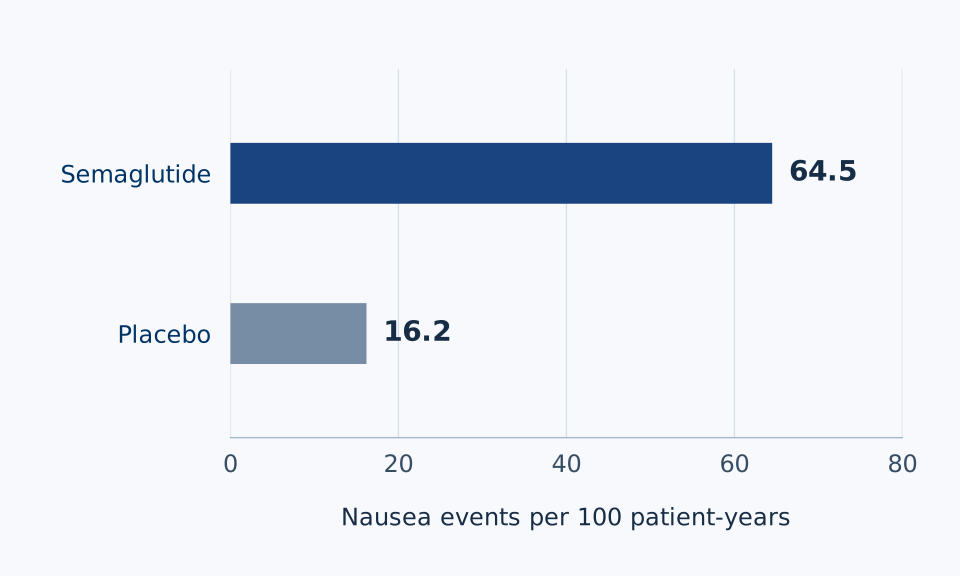
Read the chart as a table
| Arm | Nausea events per 100 patient-years |
|---|---|
| Semaglutide | 64.5 |
| Placebo | 16.2 |
Notice who enters later
STEP 4 randomized 803 of 902 entrants after a 20-week semaglutide run-in. Eligibility required reaching and retaining the target dose. Its later comparison concerned continuation or withdrawal.[3]
A decision made after an eligibility gate has a different starting point from a decision made before it. Once entry to a later comparison depends on earlier experience, the relevant population is defined partly by that history. This does not make the later question unimportant. It makes the condition for asking it important.
The distinction can be expressed without predicting who would pass the gate. A continuation question begins with a specified present situation and asks about what follows from it. A starting question must also account for the possibility of reaching that situation. Carrying the answer to the first question back to the second would require a bridge between those populations and stages. The later estimate alone cannot supply the missing bridge.
Selection should not be treated as a shorthand explanation with a known direction. Without the necessary evidence, one cannot infer that every selected participant would have done better, that every excluded participant would have done worse, or that a numerical adjustment could recover the broader answer. Those would be additional claims about people, not consequences of the word selection.
A more productive reading asks which decision remains well matched to the comparison. If the decision is conditional on a particular history, a conditional comparison may be directly relevant. If the decision precedes that history, the unanswered part must stay visible. This allows a study to be informative within its question without requiring it to resolve every earlier decision that might lead a person to the same stage.
Choose the relevant question
ICH distinguishes the treatment question from its estimator and numerical estimate. The target population, outcome and handling of treatment interruptions help define the question.[4]
The practical task is to write the question clearly enough that two readers would know what would count as an answer. Define whose outcome matters, what change would be counted and when that change would be assessed. Then consider what should happen to the question if the planned course is interrupted. These choices specify the meaning of success before a method is chosen to estimate it.
Different choices can be reasonable for different purposes. A decision about offering an intervention could require an account of what follows from that offer. A question about a particular pattern of use could instead ask what would happen under that pattern. Neither question can be declared universally superior without knowing the intended decision. Trouble arises when an answer to one is described as though it answered the other.
The same discipline applies to the outcome itself. Avoid replacing a question about the occurrence of a problem with a question about an average change in another measure. Both might matter, but combining their importance in a decision does not make them the same outcome. The peptide library can help organize further reading while the question is being clarified; its presence does not choose the question for the reader.
Once the question is explicit, uncertainty becomes easier to locate. It may concern whether the chosen method estimates the intended quantity, whether the available observations support that method, or whether that quantity is relevant to the person deciding. Resolving one of those issues does not automatically resolve the others.
Separate tolerance from benefit
Modeled gastrointestinal mediation was below one body-weight percentage point of the treatment difference.[1]
A proposed causal pathway asks what would change if an intermediate experience could be changed while the relevant surrounding conditions were held appropriately comparable. That is a stronger question than whether an experience and an outcome appear together. The association could be useful to describe, yet still leave the proposed pathway unidentified.
The difficulty is that several explanations can fit the same observed relationship. A preceding difference might influence both the intermediate experience and the outcome. Treatment might influence each through separate routes. The experience might also lie on a causal route. Distinguishing these possibilities requires assumptions or additional evidence capable of separating them. A statistical decomposition gives those assumptions a formal role; it does not remove their importance.
The unit of a decomposition matters as much as the unit of an event measure. A portion of a difference expressed on an outcome scale answers a different numerical question from a portion expressed relative to the total estimated effect. Neither should acquire a new unit during interpretation. The estimate must remain attached to the question and scale that produced it.
For an individual decision, even a well-supported account of a pathway would need a further step before becoming an instruction. Changing an intermediate experience in a model is not automatically the same intervention as any available way of changing it in practice. Nor does a group-level decomposition specify which process explains one person's outcome. The scientifically useful conclusion concerns the strength and scope of the proposed explanation. It does not turn discomfort into a treatment objective or establish a personal rule for judging benefit.
Weigh uncertainty
Novo Nordisk funded the trials and editorial assistance; three design-report authors were employees and shareholders.[2]
A disclosure helps readers identify an interest that deserves attention. It does not determine the direction or size of an error. Treating financial involvement as an automatic verdict would avoid the same methodological questions that should be asked of any analysis. Ignoring it would also discard relevant context about how evidence was produced and presented.
Separate uncertainty into questions that require different answers. Precision concerns how tightly a quantity is estimated under the chosen method. Dependence on assumptions concerns what happens if a defensible alternative account of the data is used. Applicability concerns whether the quantity being estimated addresses the decision at hand. Greater precision alone cannot repair a mismatch in the question or establish an untested assumption.
This separation also prevents a visual shortcut. A graph can make an ordering easy to see while leaving other aspects of interpretation unresolved. The reader should not infer the strength of a conclusion from the neatness of the display. Nor should a limitation in the display be treated as proof that the underlying relationship runs in some different direction.
A useful assessment asks what additional evidence would change the conclusion. Better measurement might clarify an outcome; another comparison might address an alternative explanation; a differently defined population might address applicability. These are distinct improvements. Naming the unresolved task makes uncertainty specific enough to investigate. It also keeps the assessment proportionate: a question can remain unanswered without making every part of the evidence unusable or assigning a motive to its authors.
Recognize the safety boundary
Wegovy delays gastric emptying and is not recommended with severe gastroparesis. Contraindications include personal or family history of medullary thyroid carcinoma, multiple endocrine neoplasia type 2, and prior serious hypersensitivity to its ingredients. Persistent or severe abdominal pain needs prompt assessment; dehydration can injure kidneys. Postmarketing reports alone establish neither frequency nor causation.[5]
Population interpretation and assessment of a present concern have different jobs. A frequency estimate describes a defined collection of observations. It cannot decide whether a particular experience calls for attention, establish its cause or determine which product is appropriate for a person. Using it for those purposes would ask a descriptive measure to perform an evaluation it has not supplied.
The categories in a safety statement should also retain their meaning. A limitation on recommendation and a contraindication are different kinds of instruction; neither should be rewritten as a general ranking of how worrying a symptom feels. When personal assessment is needed, the scientific question is no longer simply how an experience contributes to a group summary. The person's circumstances and the current concern must be considered directly.
Read a service claim
Compounded drugs are not FDA-approved.[6]
A service claim needs evidence about the service and the particular promise being made. A shared name, a treatment reference or a link to a scientific report cannot supply that evidence through association. The CoreAge Rx review is a place to begin checking dated provider documentation, not an estimate of an individual's treatment result.
The same separation applies when reading about product categories. Establish what is being offered before asking whether a study supports a claim about it. Then distinguish the proposed product, the services surrounding it and the outcome promised. Evidence relevant to one part of that description does not automatically establish the others. Keeping the claim specific makes it possible to identify what documentation would actually answer it.
Make the statistic useful
The final translation from evidence to a decision requires an account of consequences. Even if a group estimate were known precisely, a person would still need to decide which possible outcomes matter and how much uncertainty is acceptable for the choice being considered. Those judgments do not alter the estimate. They determine how the estimate enters the decision.
This is why a universal threshold for being reassured would be difficult to defend without first specifying the decision. The cost of drawing the wrong conclusion, the alternatives available and the value of obtaining more information can all be relevant to the reasoning. None should be silently replaced by a favorable-looking summary.
A defensible interpretation therefore preserves a distinction between what has been estimated and what would justify acting on it. The estimate can narrow uncertainty without eliminating it. A remaining uncertainty can justify seeking a different kind of evidence without making the existing estimate meaningless. This approach gives population statistics a concrete role: they inform a defined part of the decision while leaving the unresolved parts identifiable. It is more useful than asking a single statistic to supply a complete account of personal tolerance.
Reader questions
Can I read an event rate as my chance of having a symptom?
First identify what the denominator represents and whether the numerator can include repeated occurrences. A personal probability would also need a defined period and a relevant population. If those pieces are missing, converting the displayed quantity would add assumptions rather than reveal information already present. The useful response is to specify the probability wanted and seek evidence that measures it.
Which question should I decide on before comparing results?
Start with the decision the comparison is supposed to inform. Clarify whether the concern is an occurrence, its burden or another outcome, and when the answer is needed. Also identify the circumstances assumed at the decision's starting point. These choices let you assess relevance before being influenced by the apparent size or precision of a result.
Does a treatment result establish what a service will deliver?
Evidence about an intervention and evidence about an organization support different claims. To connect them, identify the exact offer and the outcome being promised, then examine documentation that addresses that connection. A scientific citation may support part of the description while leaving the service claim unanswered. The strength of the connection depends on that missing evidence, not the prominence of the citation.
What to take from the evidence
The strongest use of a population statistic is a bounded one: identify the question it can answer, preserve the conditions that give the answer meaning and decide what remains unresolved. This does not require dismissing group evidence when the decision concerns an individual. It requires resisting an unsupported change in the question. A measured occurrence should not become a complete account of burden, and an estimated comparison should not become a personal guarantee. When the remaining uncertainty concerns a different outcome, circumstance or decision stage, the next useful step is to identify the evidence appropriate to that gap. That keeps the interpretation scientifically informative while leaving personal assessment to a process capable of considering the individual situation.
Scope of this article
This article examines how group measurements can inform a personal question. It does not calculate an individual's risk, evaluate a provider's outcomes or replace clinical assessment. Its interpretation is limited to the questions and comparisons discussed; other products, circumstances and decisions require their own evidence.